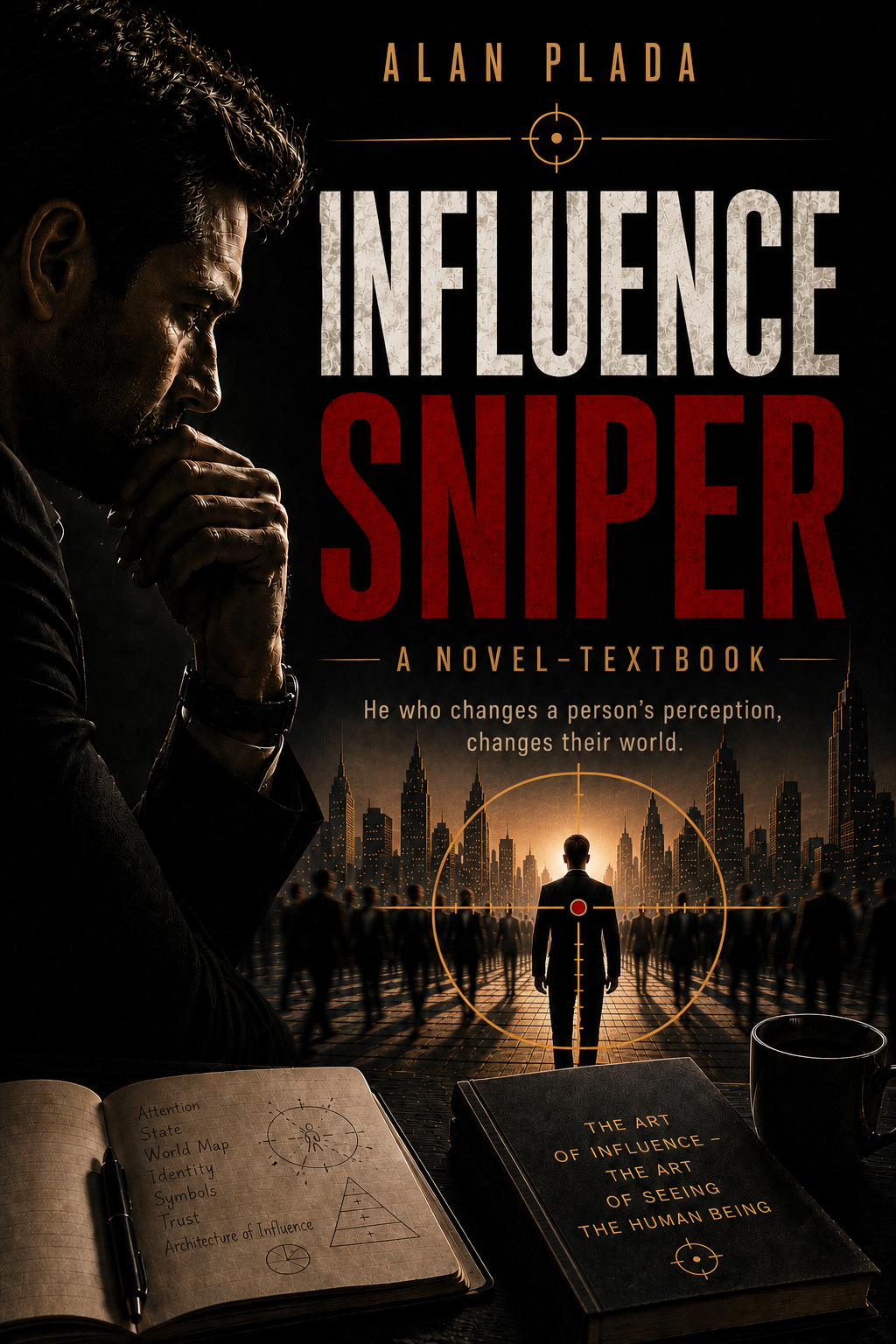
When I began writing this book, I wanted to tell a story about people who practice influence professionally.
But as the book took shape, something became increasingly clear: its real subject was much broader.
This is not a book about learning how to control other people.
It is about learning how to see a person.
To understand what lies behind their words. What shapes their decisions. What motives drive them. What they are protecting. What they are afraid to lose. What they believe. Who they believe themselves to be. And why, among all the possible choices available to them, they choose this one.
We tend to associate influence with the ability to persuade. With arguments. Charisma. Negotiation. Eloquence. Psychological techniques.
But these are only tools.
True mastery begins earlier.
With attention. With observation. With the ability to listen. With the ability to manage your own state.
With the willingness to abandon your original hypothesis when the real person in front of you turns out to be nothing like the person you imagined.
And above all, with the understanding of one simple truth:
The person before you is not an object of influence.
They are a human being.
This is where one of the most important boundaries in this book lies.
The boundary between influence and manipulation.
A manipulator looks for a way to lead another person toward the decision the manipulator wants.
An Influence Sniper tries to understand how that person’s own decision is structured. What they see. What they fail to notice. What matters to them. What options exist within their map of the world.
The Sniper may ask a question. Reveal a contradiction. Invite them to look at the situation from another perspective. Help them recognize their own deep motives.
But the decision must remain theirs.
That is the master’s responsibility.
The more deeply we are able to understand another person, the more carefully we must handle that understanding.
There is one more thought without which I would not want to end this book.
Mastery cannot be acquired by reading about it.
You can read about attention. But attentiveness must be trained.
You can understand the principle of self-control. But the ability to maintain your state under pressure is built through practice.
You can memorize dozens of questions. But the ability to sense which one should be asked now comes only after hundreds and thousands of hours of work.
Knowledge shows the direction.
Skill is built through training.
That is why Anthony Reacher, after decades of practice, still steps onto the tatami in the morning and repeats a movement he has performed countless times before.
Not because he has yet to master it.
Because he has become a master.
From the outside, we almost always see only the result of mastery.
A few minutes of conversation. A precise question. A perfectly chosen pause. Calm when everyone else is losing control. A solution found where others saw a dead end.
We do not see what came before.
Years. Mistakes. Debriefings. Books. Observation. Training. Thousands of repetitions performed when no one was watching.
And yet those are the hours that one day compress themselves into a few minutes capable of changing the course of events.
That is why this book was never intended to be a complete manual on the art of influence.
It is an introduction. A first step. An invitation into a much larger world.
We have only touched on some subjects. Others have merely been introduced. Many have remained entirely outside the boundaries of this first book.
That is exactly as it should be.
The journey from student to master cannot be completed in a single book. Just as it cannot be completed in one training program, one seminar, or one successful encounter.
Influence Sniper is the first book in a series.
From here, the world of the Academy will grow wider.
New challenges will emerge. New methods. New adversaries. New levels of training.
What the characters consider mastery today may tomorrow prove to be only the foundation for the next stage.
Because what separates a true master from a beginner is not that the master knows all the answers.
It is that the master knows how to keep learning.
But the continuation of this story will begin later.
For now, I would like to return you to the place where the novel ended.
People were walking along the sidewalks. Once, Arthur would have seen a crowd. Now he saw points of choice.
Perhaps, after reading this book, you will begin to notice them a little more often too.
In a conversation that suddenly starts going wrong. In the second before you answer. In the moment when you feel the urge to react automatically. In the possibility of asking a question instead of trying to prove a point. In the ability to understand before judging. In the decision to stop and look at the situation differently.
And above all—in your own actions.
Because the first point of choice for an Influence Sniper is almost always found within themselves.
If, after this book, you feel like opening a Field Journal—open one.
If you want to begin a Training Journal—begin.
But even more importantly, begin to observe.
Other people. Yourself. Your reactions. The way decisions are made.
Ask more precise questions. Listen more carefully. Test your own assumptions. And every day, train at least one skill a little better than you did yesterday.
Not to gain power over others.
But to become stronger in managing yourself—and more precise in understanding the person standing in front of you.
If I had to reduce this entire book to a single thought, I would put it this way:
True mastery of influence begins with mastering yourself, continues with understanding another person, and ends with respecting their right to make their own decision.
Perhaps that is why the path of an Influence Sniper never truly ends.
There is always something you have not yet noticed. Something you have not yet understood. And something you still have to learn.
Thank you for taking this journey with me.
Until the next book.
Alan Plada